
Following on from last weeks instalment of Rorke's Drift and once again, much of the narrative is taken from the excellent Osprey Campaign book Rorke's Drift by Ian Knight.

THE MAIN ATTACK.
The first rush on the hospital had just been beaten back when the main Zulu body - the uThulwana, iNdlondlo and uDloko - came into sight. Seeing the heavy fire from the back of the post, and that the iNdluyengwe were already engaged at the front, this body veered slightly to its left, passed the hospital and moved into the bush at the front in a dense mass.
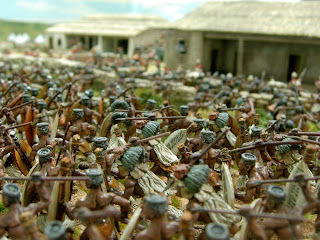

They were apparently led by two izinduna on horseback, one whose name is not recorded, was shot dead by a soldier on the back wall, and the other was Prince Dabulamanzi. Although the attack so far showed no signs of careful planning, - the Zulus had simply advanced and attacked - a directing hand became more obvious once the Prince arrived.


Once the main body had manoeuvred into position the attacks on the hospital veranda were renewed with heightened intensity. Several times the warriors rose up out of the cover and charged forward, only to be driven back after a violent melee that spilled onto the veranda itself.


Others took advantage of the bush to extend their attacks further to their left, trying to find a way in along the centre of the front barricade. The combination of rocky ledge and barricade was too much of an obstacle however and they were shot down or bayoneted as they tried to clamber up.


With the arrival of the main body the Zulus also moved to occupy the Shiyane Terrace. It was excellent natural cover and hundreds of Zulus armed with firearms nestled in among the rocks and opened a heavy fire on the back of the post.

The Zulu marksmen had an uninterrupted view into the yard and the defenders manning the front barricade had their backs exposed to the hill.


Chard could do little but order the men on the back barricade, who were comparatively safe, to suppress the Zulu fire as best they could.


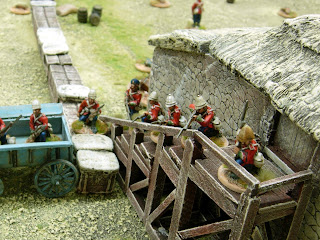
Chaplain Smith hands out ammunition to the defenders on the South wall.

The battle had now been raging for almost an hour, and the casualties in the yard were beginning to mount up and causing Chard some concern. The attacks on the front wall showed no signs of abating and the defenders had finally been driven off the veranda, and had retired to an improvised dog-leg barricade which connected the front right corner of the hospital to the front wall.. From here they could rake the front of the hospital with rifle fire, although dozens of warriors pressed themselves against the walls in the blind spots and tried to batter their way in through the front doors.


Furthermore, the attacks along the centre of the front wall were now even more determined.


A serious assault took place on the barricade directly in front of the storehouse. A track ran up to the buildings there through the ledge, and although it had been blocked off with mealie-bags, it provided less of an obstacle to the attackers.


Chard gathered two or three men to meet the rush, and was joined by Bromhead with two or three more.


It was repulsed, but Chard was concerned that his mounting casualties in the yard might leave a section of the wall undefended. At about 6.00pm he gave the order for his men to abandon the yard and retreat back behind the interior partition of biscuit-boxes. The wounded were dragged inside the new perimeter but there was no time to carry away the dead.


The new position offered Chard a number of advantages. It was almost entirely protected from fire from the hill by the storehouse, and he had the same number of men to defend a much smaller area.

It did mean, however, that the Zulus would now rush forward and occupy the area at the foot of the old front wall, which was effectively dead ground.


Here dozens of them could mass, untouched by British fire. Worse still it meant that it was impossible to keep them away from the hospital, which was now an isolated bastion, defended only by its patients and a handful of able bodied men, in the midst of ground occupied by the enemy.

NEXT WEEK..............................THE FIGHT FOR THE HOSPITAL.


THE MAIN ATTACK.
The first rush on the hospital had just been beaten back when the main Zulu body - the uThulwana, iNdlondlo and uDloko - came into sight. Seeing the heavy fire from the back of the post, and that the iNdluyengwe were already engaged at the front, this body veered slightly to its left, passed the hospital and moved into the bush at the front in a dense mass.


They were apparently led by two izinduna on horseback, one whose name is not recorded, was shot dead by a soldier on the back wall, and the other was Prince Dabulamanzi. Although the attack so far showed no signs of careful planning, - the Zulus had simply advanced and attacked - a directing hand became more obvious once the Prince arrived.


Once the main body had manoeuvred into position the attacks on the hospital veranda were renewed with heightened intensity. Several times the warriors rose up out of the cover and charged forward, only to be driven back after a violent melee that spilled onto the veranda itself.


Others took advantage of the bush to extend their attacks further to their left, trying to find a way in along the centre of the front barricade. The combination of rocky ledge and barricade was too much of an obstacle however and they were shot down or bayoneted as they tried to clamber up.


With the arrival of the main body the Zulus also moved to occupy the Shiyane Terrace. It was excellent natural cover and hundreds of Zulus armed with firearms nestled in among the rocks and opened a heavy fire on the back of the post.

The Zulu marksmen had an uninterrupted view into the yard and the defenders manning the front barricade had their backs exposed to the hill.

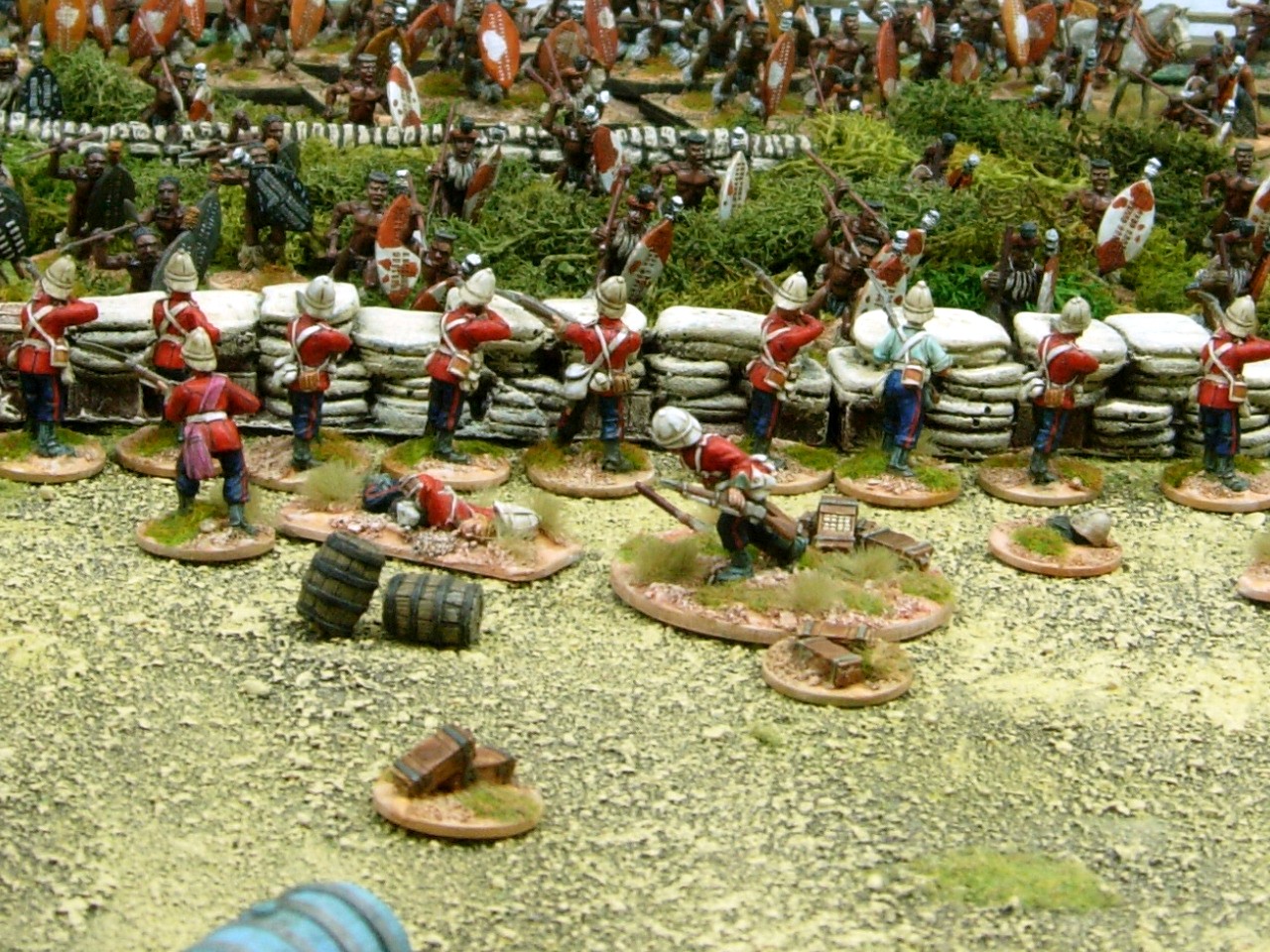
Chard could do little but order the men on the back barricade, who were comparatively safe, to suppress the Zulu fire as best they could.


The battle had now been raging for almost an hour, and the casualties in the yard were beginning to mount up and causing Chard some concern. The attacks on the front wall showed no signs of abating and the defenders had finally been driven off the veranda, and had retired to an improvised dog-leg barricade which connected the front right corner of the hospital to the front wall.. From here they could rake the front of the hospital with rifle fire, although dozens of warriors pressed themselves against the walls in the blind spots and tried to batter their way in through the front doors.


Furthermore, the attacks along the centre of the front wall were now even more determined.


A serious assault took place on the barricade directly in front of the storehouse. A track ran up to the buildings there through the ledge, and although it had been blocked off with mealie-bags, it provided less of an obstacle to the attackers.


Chard gathered two or three men to meet the rush, and was joined by Bromhead with two or three more.


It was repulsed, but Chard was concerned that his mounting casualties in the yard might leave a section of the wall undefended. At about 6.00pm he gave the order for his men to abandon the yard and retreat back behind the interior partition of biscuit-boxes. The wounded were dragged inside the new perimeter but there was no time to carry away the dead.


The new position offered Chard a number of advantages. It was almost entirely protected from fire from the hill by the storehouse, and he had the same number of men to defend a much smaller area.

It did mean, however, that the Zulus would now rush forward and occupy the area at the foot of the old front wall, which was effectively dead ground.


Here dozens of them could mass, untouched by British fire. Worse still it meant that it was impossible to keep them away from the hospital, which was now an isolated bastion, defended only by its patients and a handful of able bodied men, in the midst of ground occupied by the enemy.

NEXT WEEK..............................THE FIGHT FOR THE HOSPITAL.


